
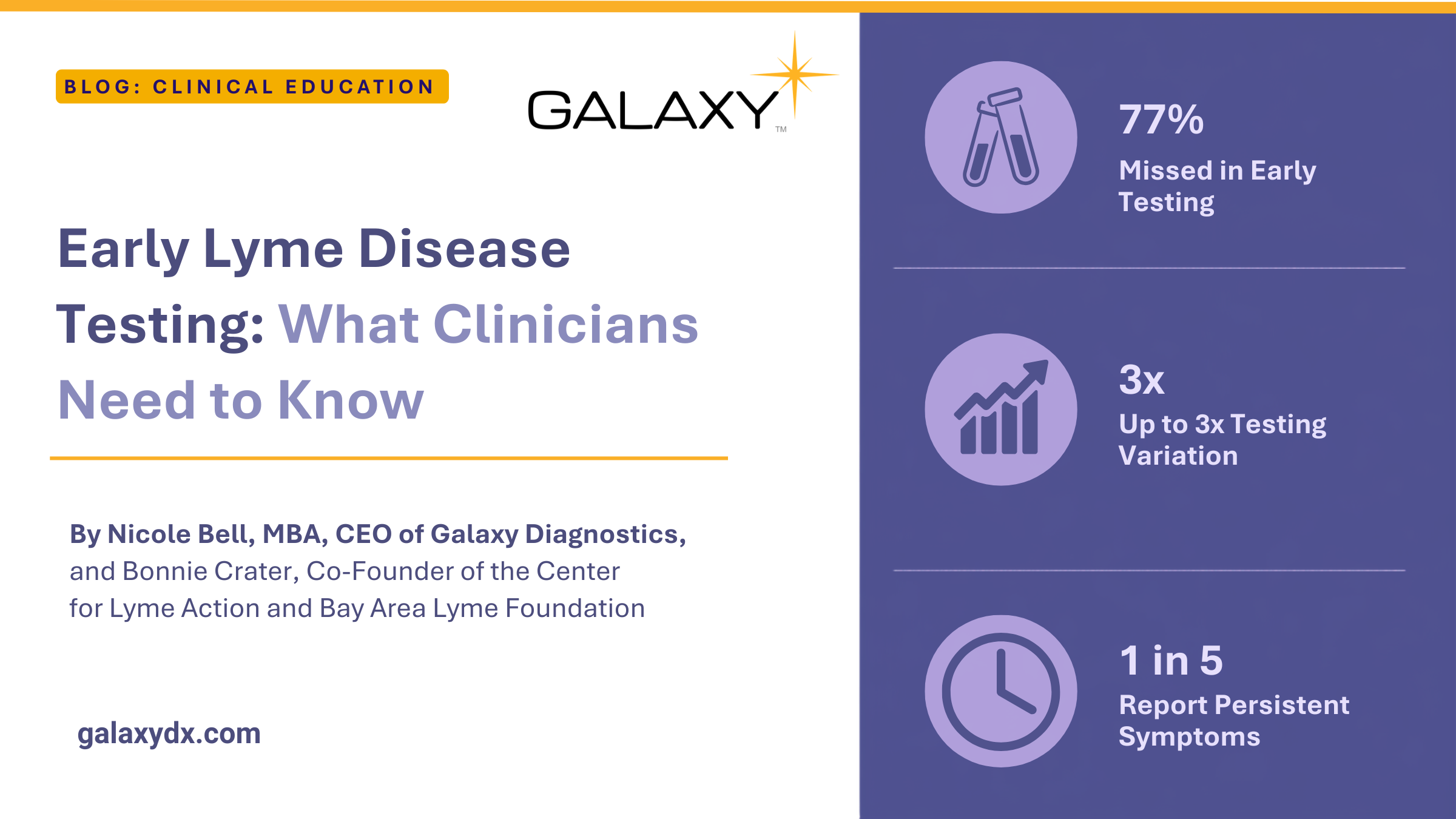
By Nicole Bell, MBA, CEO of Galaxy Diagnostics, and Bonnie Crater, Co-Founder of the Center for Lyme Action and Bay Area Lyme Foundation. Moderated by Dr. Amy Offutt, MD, Immediate Past President of the International Lyme and Associated Diseases Society (ILADS)
Summary: Research published between 2024 and 2026 sharpens understanding of why early Lyme disease testing misses so many patients, and what that means for clinicians managing complex, multisystem presentations. This post reviews why standard two-tier testing underperforms in early disease, how sex and hormonal status alter serologic performance, emerging diagnostic approaches moving toward FDA approval, the biological basis of persistent post-treatment symptoms, and what the current treatment evidence shows. All statistics are drawn from peer-reviewed or preprint publications confirmed in the April 2026 webinar transcript. Citation details are provided in the References section and must be verified by the Galaxy scientific team prior to publication.
Download the State of Lyme Disease Research Papers
This article summarizes key findings discussed in the current Lyme disease research update. For additional background and source-level context, clinicians can download the original State of Lyme Disease Research in the United States paper from the Center for Lyme Action. The newest edition will be added here once available.
Table of Contents
Over the last 18 to 24 months, a concentrated volume of research has refined our understanding of Lyme disease diagnosis, persistent symptoms following treatment, and emerging therapeutic directions. This post reviews the research, clarifies what the data shows, acknowledges important limitations, and connects the findings to the clinical decisions providers face in complex cases.
The research covered here was curated directly from leading investigators in the Lyme disease space and organized into three areas: diagnosis, the link to chronic conditions, and treatment. It is not exhaustive, but it represents meaningful progress made since 2024 and the clinical implications that come with it.
The Diagnostic Gap: Why Standard Testing Misses Early Lyme Disease
The most consequential failures in the current Lyme disease diagnostic system concentrate at the moment when treatment could make the greatest difference: early infection. Multiple studies confirm three realities that remain underappreciated in clinical practice.
Rash-Based Diagnosis Has Significant Limitations
The erythema migrans (EM) rash remains heavily weighted in Lyme disease diagnosis, including in surveillance case definitions and clinical diagnostic frameworks [1,2]. However, published data show important limitations to relying on rash appearance alone [1–3]. Central clearing, the feature often associated with the classic “bullseye” rash, is reported in only about 19% of EM cases in endemic U.S. studies [2]. In national surveillance data, EM was indicated in 72.2% of confirmed case reports with clinical-manifestation information, meaning approximately 27.8% of those reports did not indicate EM [1]. Clinical recognition is also imperfect: in an endemic region, general practitioners correctly recognized erythema chronicum migrans in about 72% of cases, meaning roughly 28% would have been missed or misidentified [3]. Rash recognition may also be more challenging across diverse skin tones, where erythema can appear with less visible redness or varying contrast.
Taken together, these data suggest that rash-based assessment alone may miss the majority of patients with Lyme disease, including those who never develop a rash and those whose rash pattern is misidentified at presentation. A patient told “no rash, no Lyme” years ago may have been missed at the exact moment when early treatment was most accessible.
The Two-Tier Test Underperforms in Early Disease
Standard two-tier testing (STTT) and Modified Two-Tier Testing (MTTT) both detect antibodies to Borrelia burgdorferi, measuring the host’s immune response rather than the pathogen itself. Both algorithms share a fundamental timing problem: antibodies take weeks to develop, but the optimal treatment window is earlier.
Data from the Bay Area Lyme Foundation biobank, drawn from a study of 466 early Lyme cases enrolled over a decade, found that only 23% of patients tested positive at the first blood draw, meaning 77% were missed at that initial encounter [4]. A head-to-head comparison of four FDA-cleared Lyme tests, also using Bay Area Lyme biobank samples, found that in early-stage disease, these tests miss between 64% and 78% of patients. Within the first week of symptom onset, the majority of patients tested negative on every algorithm evaluated. Detection improved only after two weeks, by which point the early treatment window had passed [5].
A note on early treatment and test performance: Early antibiotic treatment, which is clinically appropriate, can limit the antibody response the two-tier test is designed to detect. A negative follow-up draw cannot therefore be taken as definitive evidence that the patient was not infected. Of patients who initially tested negative for IgG antibodies in the Bay Area Lyme biobank study, only 4% later converted to positive at the three-month post-treatment visit [4].
What This Means for Testing
Standard two-tier serology was designed around acute infection biology. It was not designed to detect Borrelia burgdorferi in the first week of illness, in patients who mount a suboptimal antibody response, or in patients who were treated early. Therefore, a negative result in any of these scenarios does not rule out infection. Direct detection methods that identify pathogen-derived markers or genetic material independent of the antibody response address a structural gap the current standard does not fill.
Sex Differences in Serologic Performance and Disease Presentation
A prospective study from Johns Hopkins investigators of 243 antibiotic-naive adults (all presenting with an EM rash) documented significant differences in serologic performance and disease presentation based on sex and menopausal status. Compared to women overall, men were nearly twice as likely to test positive on the two-tier test and presented with more severe symptoms and larger rashes. That gap widens when comparing men specifically to premenopausal women: men were almost three times more likely to test positive, and symptoms were more than twice as severe [6].
Premenopausal women appear to mount a less robust antibody response during early disease, and the clinical presentation may be less pronounced. This means both the serologic test and the clinical picture are more likely to be missed in this group. Some patients receive a diagnosis as they approach menopause, not because they were recently infected, but because shifting hormone levels may intensify symptoms that were present but subclinical for years.
What This Means for Testing
The standard two-tier serologic test is harder to trust in younger women. In this group, clinical interpretation is further complicated by the fact that common Lyme disease symptoms are often non-specific and may not appear as clearly differentiated from other chronic or multisystem presentations. As a result, premenopausal women may face a higher risk of missed or delayed recognition when testing and symptom presentation are interpreted in isolation. Direct detection methods that measure pathogen-derived markers or genetic material independent of antibody titer are particularly relevant for patients where clinical suspicion is high but serology is ambiguous.
New Diagnostic Approaches on the Horizon
Better serologic testing is in development. Two approaches with improved performance over the standard two-tier algorithm have been published in the last 18 months, and a third is in preprint. All three signal that design is not the ceiling for antibody-based testing.
NIH Dual-Binding ELISA
Research from the National Institutes of Health describes a redesigned ELISA that requires two Borrelia targets to bind simultaneously before calling a positive result. This dual-binding requirement was observed to reduce false positives while improving early sensitivity. In the published study, 15 of 15 early cases were accurately identified within the first seven days of symptoms, compared to 76% with the modified two-tier algorithm [5]. This test is currently in prospective clinical trials.
Machine Learning-Based Antibody Testing (nBio)
A platform developed at nBio screens antibodies against nine Borrelia proteins and uses a machine learning algorithm to combine multiple weak signals into a single call. In early patients tested within the first seven days of symptoms, detection improved from 10% to 30% compared to standard testing [8]. This test is currently for research use only and has not received FDA clearance. Independent replication and larger prospective studies are needed before clinical application.
Lyme-seq (ACES Diagnostics)
A preprint from Stafford and colleagues at ACES Diagnostics describes a test called Lyme-seq that examines antibody responses to 10 Borrelia antigens on the Luminex platform, which is already installed in most large reference laboratories. Using the Johns Hopkins SLICE cohort, Lyme-seq showed 100% sensitivity in early Lyme disease at diagnosis, 100% sensitivity again at the three-month post-treatment visit, and 95% sensitivity in PTLDS patients, compared to 43% for the standard two-tier algorithm in that same group [9].
Important caveat: The ACES Diagnostics authors explicitly note that a positive result cannot distinguish current pathogen presence from resolved prior exposure with persistent antibodies. It is an antibody-based approach that addresses the sensitivity problem but does not independently establish current pathogen status. This study is currently a preprint and has not yet completed peer review.
What This Means for Testing
Both the NIH and nBio approaches demonstrate that smarter antibody testing is possible and that design is not the ceiling. All three approaches address the sensitivity problem. None, on their own, resolve the fundamental limitation of antibody-based testing: the inability to distinguish current pathogen presence from prior exposure. That distinction requires direct detection.
The Push Toward Direct Detection of Current Pathogen Presence
The LymeX Diagnostic Prize, a public-private partnership between the Steven and Alexandra Cohen Foundation and the U.S. Department of Health and Human Services, launched in 2022 with the goal of supporting teams developing improved Lyme testing solutions through to FDA approval. The program is currently in Phase 4, which supports seven teams through FDA submission.
Disclosure: Galaxy Diagnostics is one of the seven teams currently participating in Phase 4 of the LymeX prize.
The gap this initiative was designed to address is one that has existed in the field for decades: the ability to detect current pathogen presence, not just exposure history, not just antibody evidence of prior immune response, but evidence of the pathogen itself. Two broad approaches are in development: direct detection, looking for the bacteria or its biomarkers in patient samples; and pattern-based immune profiling, using the immune response signature to indicate current pathogen presence rather than past exposure.
The Biology of Urine-Based Detection
Published research described in the April 2026 webinar explains the biological basis for urine as a compelling sample type for direct Borrelia detection. Borrelia produces roughly 38,000 membrane vesicles per organism over a 10-day culture period. These vesicles are small enough to travel throughout the body, including into the nervous system and joints, and are filtered by the kidneys and excreted in urine along with the proteins they contain. One study identified 289 distinct Borrelia proteins in human urine samples, providing a biological rationale for urine-based antigen detection independent of the host antibody response [10].
Galaxy Diagnostics and the Jutras Research Partnership
At the end of 2025, Galaxy Diagnostics entered a research partnership with Dr. Brandon Jutras at Northwestern University, combining efforts on urine antigen-based approaches for Borrelia detection as part of the LymeX Phase 4 program.
Published work from Dr. Jutras’s laboratory documents that Borrelia sheds approximately 45% of its cell wall material into surrounding tissue each time it divides, and that cell wall-disrupting antibiotics such as amoxicillin and ceftriaxone trigger an even larger burst of released cell wall material. The research makes an important mechanistic distinction: cell wall material exists in two forms, smaller fragments and intact peptidoglycan polymer chains. The fragments are cleared from the body relatively quickly. The intact polymer form is not. It accumulates in the liver, persists for weeks, and has been detected in the joint fluid of 27 out of 30 post-treatment Lyme arthritis patients tested following antibiotic treatment [11].
The intact polymer drives immune activation in a way the fragments do not, and may contribute to understanding why some patients remain symptomatic after treatment. This is a plausible mechanistic pathway, not a clinical determination. Clinical correlation and additional validation are required.
What This Means for Testing
When a treated patient remains symptomatic, persistent cell wall material may be part of the explanation. Even if antibiotics clear the bacteria, the debris can still remain , and not all debris is biologically equivalent. To learn more about Galaxy’s urine antigen testing approach for Lyme disease, including the Lyme Borrelia Direct Detect test, visit our testing methodology page.
Linking Lyme to Chronic Conditions: The Biology Behind Persistent Symptoms
For providers working with patients who remain symptomatic after treatment, several biological mechanisms are increasingly well-characterized in the peer-reviewed literature. Each paper in this section adds a new dimension to understanding why so many patients remain sick after standard treatment.
Tick Saliva and the Disruption of Skin Immune Response
Research from investigators in Vienna documents what happens to the skin’s immune cells, called Langerhans cells, during tick attachment and before Borrelia has even been transmitted. Tick saliva reprograms these cells from an alert, fight-ready state into a tolerating, stand-down state. When Borrelia arrives, this tolerogenic effect is amplified: the cells double down on tolerance rather than mounting an alarm [12]. The result is that the immune response that should be clearing the pathogen does not mount properly. This mechanism also helps explain why some patients never produce a robust enough antibody response to test positive, and why reinfection is possible without strong immune memory.
Persistent Cell Wall Material and Post-Treatment Symptoms
Recent research by McClune et al. observed that Borrelia burgdorferi peptidoglycan (a structural component of the bacterial cell wall) can persist in specific tissues after antibiotic treatment and continue to drive inflammatory immune responses [11]. As peptidoglycan is a durable structural remnant rather than a marker of active replication, its persistence offers a plausible biological mechanism for ongoing post-treatment symptoms even after viable organisms have been cleared. This carries an important interpretive point: detecting peptidoglycan reflects the presence of immunogenic, pathogen-derived material and associated immune activity; it does not, on its own, confirm ongoing viable infection. That distinction is specific to a persistent structural antigen like peptidoglycan and should not be generalized to all pathogen-derived markers; what a given assay tells you depends on the marker it targets. Interpretation of persistent symptoms after completed therapy continues to require clinical judgment and additional evaluation.
The Type I Interferon Pathway
Research from investigators at Indiana University documents that Borrelia burgdorferi secretes a molecule that activates the STING pathway, which typically responds to viral DNA rather than bacterial pathogens [13]. STING activation triggers the production of type I interferons, signaling proteins that amplify the immune response. Early in infection, this is likely protective. However, persistent STING activation can drive chronic inflammation and tissue damage. This same STING/TBK1 pathway is also currently under investigation in long COVID research, and existing therapeutic targets in that context may have relevance to post-treatment Lyme disease as well. This is an emerging research direction, not an established treatment pathway.
Autonomic Dysfunction and POTS: An Understudied Connection
A review paper from Johns Hopkins investigators documents that Borrelia burgdorferi possesses the biological mechanisms known to produce autonomic dysfunction and postural orthostatic tachycardia syndrome (POTS): nervous system involvement, nerve damage, autoimmune responses, and disrupted blood-brain barrier function [14]. Critically, no formal prospective study has yet examined whether Borrelia causes POTS in the PTLDS population, even though effective treatments for POTS are actively being trialed in long COVID patients. The paper calls for that research. For clinicians whose patients describe autonomic symptoms alongside a history of tick-borne illness, this review provides a plausible biological rationale for further evaluation. It is also a useful tool to share with colleagues who question whether Lyme disease can underpin common autonomic symptoms patients describe.
Lyme Disease and Gynecological Conditions
A study from MIT investigators combined animal models with analysis of three large U.S. health databases, covering data from approximately 110 million patients across 30 health systems. In one animal model, Borrelia was detected in uterine tissues within weeks of infection and persisted for the lifespan of the animal, with associated uterine inflammation and cyst formation. In the human database analysis, consistent across all three independent databases, women diagnosed with Lyme disease showed elevated associations with endometriosis, miscarriage, uterine fibroids, heavy/painful periods, and uterine polyps [15].
Important epidemiological caveat: This research does not establish causation. The associations were observed following the Lyme diagnosis, not preceding it, and the signal held after controlling for antibiotic use. Observational data, even large-scale and replicated across three independent databases, cannot substitute for prospective studies designed to test a causal hypothesis. For clinicians working with female patients who have unexplained gynecological symptoms and a documented history of tick-borne illness, this data warrants clinical consideration and further investigation.
Congenital Transmission: A Neglected Research Area
A review paper summarized in the April 2026 webinar covers congenital Borrelia transmission, a topic largely absent from the research agenda since approximately 2000 despite case reports dating to the 1980s [16]. Documented cases in the literature include miscarriages, cardiac malformations, stillbirths, and neonatal deaths.. The World Health Organization recently removed congenital Lyme disease in the last stage of ICD-11 editing. Currently, their stated position is that there is not yet sufficient evidence to include congenital Lyme as a distinct concept. Furthermore, U.S. medical guidelines currently make no specific recommendations for exposed newborns, and the incidence of perinatal transmission remains unknown. For clinicians treating a Lyme-positive patient who is pregnant or planning to become pregnant, this gap in guidance is a conversation worth initiating.
What This Means for Testing and Clinical Practice
The biology of why patients get missed and stay sick is no longer theoretical. We are beginning to understand core mechanisms: persistent cell wall material, chronic interferon activation, tick saliva-mediated immune reprogramming, autonomic dysfunction pathways, and tissue-specific persistence. These are documented biological findings, not speculative claims. Understanding them changes how providers interpret negative test results, how they follow up with patients after treatment, and which symptom constellations they connect to a prior tick-borne exposure. For co-infection considerations across Borrelia, Bartonella, and Babesia, see the companion post Why Tick-Borne Pathogens Are So Hard to Detect.
Treatment Advances: What the Evidence Shows
Current standard treatments leave a subset of patients with persistent symptoms. The evidence base for alternative approaches is building, but most findings are preclinical or from small pilot studies. Clinical judgment must guide how these findings are applied. The goal of this section is to document what the data shows and where the field is heading, not to make treatment recommendations.
Post-Treatment Symptom Burden: Data from the Bay Area Lyme Biobank
The same Bay Area Lyme Foundation biobank study referenced in the diagnostics section provides a treatment-relevant finding. Of the 253 patients with three-month follow-up data, 22% reported ongoing symptoms after antibiotic treatment- most commonly joint pain, fatigue, and muscle pain. Of those patients with persistent symptoms, only 35% returned to see their provider [4]. Two-thirds of early Lyme patients with symptoms after treatment did not seek additional medical care, representing a significant care gap. Early Lyme disease is not a one-visit encounter. These patients warrant follow-up at three months, and persistent symptoms are a clinical signal that deserves evaluation.
Combination Therapy vs. Monotherapy: Preclinical Data
In a study from Tulane University, investigators compared monotherapy and combination antibiotic regimens using a xenodiagnostic design(testing whether treated mice could still transmit Borrelia to feeding ticks). With every monotherapy evaluated (eight were tested), viable, transmissible organisms were recovered from feeding ticks. Conversely, with every combination regimen evaluated (seven were tested), no transmission was detected [17].
It is important to note that these are animal model results. They have not yet been validated in human clinical trials. They offer a mechanistic rationale for investigating multi-drug approaches, consistent with what some clinicians have observed in complex presentations. They do not constitute a clinical treatment recommendation.
Piperacillin: A Microbiome-Sparing Candidate
Research from Northwestern University investigators screened 466 FDA-approved compounds at low doses against Borrelia and other bacterial cultures. Piperacillin demonstrated selective biological activity against Borrelia and cleared the pathogen in a mouse model at a dose approximately 100 times lower than doxycycline. Critically, piperacillin had negligible impact on the gut microbiome in the study model, while doxycycline produced marked disruption of microbiome composition [18]. For patients who have struggled with the gastrointestinal consequences of long-term doxycycline therapy, this line of research matters.
Piperacillin is a beta-lactam antibiotic currently approved for intravenous use in hospital settings. The route of administration and dosing for any potential outpatient application would require extensive clinical development. This is a preclinical screening candidate, and human trials are a necessary next step before any translation to clinical practice.
Psilocybin-Assisted Therapy for PTLDS: A Small Pilot
A pilot study from Johns Hopkins investigators enrolled 20 patients meeting criteria for post-treatment Lyme disease syndrome, all with CDC-confirmed Lyme disease, experiencing symptoms with a median duration of nearly six years. Two psilocybin sessions were administered over an eight-week program. In this open-label, uncontrolled pilot, self-reported general symptom burden decreased approximately 40% from baseline, and that reduction was maintained at the six-month follow-up. Quality of life scores improved 13%, and improvements were seen across depressive symptoms, sleep, fatigue, and pain [18].
This was an open-label pilot with no control group and 20 participants. Without a control arm, observed changes cannot be attributed definitively to the intervention. Independent replication in adequately powered, controlled trials is necessary before clinical conclusions can be drawn. Psilocybin remains a Schedule I controlled substance in the United States. This research is noted because it appears in the peer-reviewed literature, not as a clinical recommendation.
The Lyme Clinical Trials Network
The Lyme Clinical Trials Network, funded by the Cohen Foundation with sites also funded by the Bay Area Lyme Foundation and the NIH, currently has seven active studies enrolling patients. For clinicians who may want to refer qualifying patients, and for those interested in monitoring emerging evidence, these trials are worth following as new studies are added.
What This Means for Clinical Practice
Three takeaways emerge from the research published in the last 18 to 24 months.
Diagnostics
The current system is broken, and the data proves it, but better tests are coming. The two-tier test has documented performance limitations in early Borrelia burgdorferi infection, particularly in the first two weeks of symptoms and in premenopausal women. Direct detection methods that identify pathogen-derived markers independent of the antibody response address a structural gap the current standard cannot fill. Galaxy’s Lyme Borrelia Direct Detect test, which detects OspA antigen in urine, is one example of this category. A negative antibody result in a patient with consistent clinical presentation warrants further evaluation rather than automatic exclusion of Borrelia involvement.
Chronic Conditions
The biology of why patients get missed and stay sick is no longer theoretical. The biological pathways linking Borrelia to persistent post-treatment symptoms are becoming increasingly well-characterized: persistent cell wall material, chronic STING pathway activation, tick saliva-mediated immune reprogramming, tissue-specific immune dysregulation, and emerging associations with gynecological conditions and autonomic dysfunction. These are documented biological findings that support continued investigation, not speculative claims.
Treatment
Better solutions are under evaluation . Preclinical evidence supports investigating combination antibiotic approaches. Microbiome-sparing alternatives to doxycycline are in early development. Pilot data on novel interventions for PTLDS exist but require controlled replication. The Lyme Clinical Trials Network is building the evidence base the field requires to move forward.
Frequently Asked Questions
Why does the two-tier test miss so many early Lyme patients?
The two-tier test detects antibodies, which take time to develop. In early infection, particularly within the first week of symptoms, most patients have not yet mounted a detectable antibody response. In a head-to-head study of four FDA-cleared Lyme tests using well-characterized early-disease samples, the majority of patients tested negative on all algorithms in the first week, with detection improving only after approximately two weeks [5]. Early antibiotic treatment can also limit the antibody response that the test is designed to detect. A negative follow-up draw cannot be taken as definitive evidence that the patient was not infected [4]. For more on direct testing approaches that do not depend on antibody timing, see Galaxy’s testing methodology.
Do women and men respond differently to Lyme testing and disease presentation?
Yes. A prospective Johns Hopkins study of 243 antibiotic-naive adults found that men were nearly twice as likely to test positive on the two-tier test compared to women overall, and almost three times more likely compared to premenopausal women specifically [6]. Men also presented with more severe symptoms and larger rashes. Premenopausal women appeared to mount a less robust antibody response during early disease, and the clinical presentation may also be less pronounced, making both the test and the clinical picture easier to miss.
What is the difference between antibody testing and direct detection?
Antibody testing (serology) measures the host’s immune response. Antibodies can persist long after pathogen clearance, making it difficult to distinguish current pathogen presence from prior exposure. Direct detection methods identify the pathogen itself or its components, such as bacterial DNA via PCR or specific proteins shed into urine. Galaxy’s Lyme Borrelia Direct Detect test detects OspA antigen in urine independent of the antibody response. Both approaches have clinical value; the strongest diagnostic strategy pairs them. Learn more about direct vs. indirect testing for tick-borne disease.
Can Lyme disease be associated with gynecological conditions?
An observational study from MIT investigators found elevated associations between Lyme disease diagnosis and endometriosis, miscarriage, uterine fibroids, heavy/painful periods, and uterine polyps across three independent health databases covering approximately 110 million patients [15]. In animal models, Borrelia was detected in uterine tissues and persisted through the animal’s lifespan. These findings do not establish causation. The associations developed after the Lyme diagnosis, not before, and held after controlling for antibiotic use. Prospective studies are needed to bring further clarity.
What is post-treatment Lyme disease syndrome (PTLDS)?
PTLDS refers to persistent symptoms, including fatigue, joint pain, cognitive difficulties, and sleep disturbances, that continue after standard antibiotic treatment for Lyme disease. In a prospective Bay Area Lyme Foundation biobank study, 22% of early Lyme patients reported ongoing symptoms at three months following treatment [4]. The mechanisms underlying PTLDS may include persistent Borrelia cell wall material that remains biologically active after antibiotic therapy [11] and chronic activation of the type I interferon pathway [13]. These findings reflect biological complexity that may not be fully resolved by initial antibiotic therapy in some patients.
Why is combination antibiotic therapy being studied?
Preclinical research from Tulane University investigators found that in a xenodiagnostic animal model, every monotherapy evaluated (eight antibiotics tested) left viable, transmissible Borrelia detectable in feeding ticks [17]. Every combination regimen evaluated (seven tested) produced no detectable transmission in the same model. This is animal data requiring validation in human clinical trials. It provides a mechanistic rationale for further investigation, not a clinical recommendation.
What is the LymeX Diagnostic Prize?
The LymeX Diagnostic Prize is a public-private partnership between the Steven and Alexandra Cohen Foundation and the U.S. Department of Health and Human Services. It supports teams developing improved Lyme disease testing with the goal of accelerating diagnostics to FDA approval. The program is currently in Phase 4. Galaxy Diagnostics is one of seven participating teams. The program addresses a longstanding gap: the ability to assess current pathogen presence rather than relying solely on historical exposure or antibody response.
References
- Schwartz AM, Hinckley AF, Mead PS, et al. Surveillance for Lyme Disease — United States, 2008–2015. MMWR. 2017.
- Tibbles CD, Edlow JA. Does this patient have erythema migrans? JAMA. 2007.
- Lipsker D, Lieber-Mbomeyo A, Hedelin G. How accurate is a clinical diagnosis of erythema chronicum migrans? Arch Dermatol. 2004.
- Horn EJ, Dempsey G, Schotthoefer AM, et al. Lyme Disease Biobank: 10 years of 3 month follow-up visits from 2014 to 2023. Front Med (Lausanne). 2025;12:1577936. doi:10.3389/fmed.2025.1577936
- Horn EJ, Menefee B, Schotthoefer AM, et al. Evaluation of standard and modified two-tiered testing algorithms using well-characterized early Lyme disease samples. J Clin Microbiol. 2026;64(5):e0118725. doi:10.1128/jcm.01187-25
- Rebman AW, Yang T, Aucott JN. Sex and menopause-based differences in presentation of early Lyme disease: A prospective cohort study. Clin Exp Med. 2026;26(1):139. doi:10.1007/s10238-026-02063-0
- Levin AE, Wormser GP, Horn EJ, et al. A novel single-tier serologic test to diagnose all stages of Lyme disease. J Clin Microbiol. 2025;63(9):e0048325. doi:10.1128/jcm.00483-25
- Hickman AF, Weber AF, Horn EJ, Gwynne PJ. The multiplexed single-tier InBios Lyme Detect Multiplex ELISA is more sensitive than standard two-tier tests in the early stages of Lyme disease. J Clin Microbiol. 2025;63(11):e0062925. doi:10.1128/jcm.00629-25
- Embers ME, Stafford P, Ahern, H., et al. Multiplexed single-tier immunoassay for improved Lyme disease diagnosis across all disease stages, 09 February 2026, PREPRINT (Version 1) available at Research Square https://doi.org/10.21203/rs.3.rs-8502997/v1
- Birkaya B, Byne A, Irfan S, et al. Characterization of Borrelia-Derived Extracellular Vesicles: Implications for Pathogenesis and Diagnostics. Microorganisms. 2026;14(3):600. doi:10.3390/microorganisms14030600
- McClune ME, Ebohon O, Dressler JM, et al. The peptidoglycan of Borrelia burgdorferi can persist in discrete tissues and cause systemic responses consistent with chronic illness. Sci Transl Med. 2025;17(795):eadr2955. doi:10.1126/scitranslmed.adr2955
- Strobl J, Kleissl L, Eder J, et al. Human epidermal Langerhans cells induce tolerance and hamper T cell function upon tick-borne pathogen transmission. Nat Commun. 2025;16(1):11715. doi:10.1038/s41467-025-66821-6
- Priya R, Ye M, Raghunanadanan S, et al. Borrelia burgdorferi c-di-AMP is a key extracellular pathogen-associated molecular pattern to elicit type I interferon responses in mammalian hosts. J Immunol. 2025;214(9):2325-2337. doi:10.1093/jimmun/vkaf133. Note that this citation is now peer-reviewed and has been published (not preprint)
- Adler BL, Chung T, Rowe PC, Aucott J. Dysautonomia following Lyme disease: a key component of post-treatment Lyme disease syndrome?. Front Neurol. 2024;15:1344862. doi:10.3389/fneur.2024.1344862
- Hansen Colburn PS, Blacker G, Galloway S, et al. Lyme disease increases risk for multiple gynecological conditions. medRxiv. 2025. doi:10.1101/2025.03.03.25323258
- Faber S, Mao C, Darling E, et al. Perinatal transmission of Borrelia burgdorferi: advancing scientific and clinical understanding of Lyme disease in pregnancy. Front Med (Lausanne). 2026;13:1794120. doi:10.3389/fmed.2026.1794120
- Alruwaili Y, Jacobs MB, Hasenkampf NR, et al. Superior efficacy of combination antibiotic therapy versus monotherapy in a mouse model of Lyme disease. Front Microbiol. 2023;14:1293300. doi:10.3389/fmicb.2023.1293300
- Garcia-Romeu A, Naudé GP, Rebman AW, et al. Pilot study of psilocybin in patients with post-treatment lyme disease. Sci Rep. 2026;16(1):7497. doi:10.1038/s41598-026-38091-9. This study was approved by an Institutional Review Board at the Johns Hopkins University School of Medicine
About Galaxy Diagnostics
Galaxy Diagnostics provides evidence-driven direct and indirect testing tools for clinicians evaluating complex vector-borne and zoonotic disease cases. The company focuses on diagnostic clarity, scientific precision, and clinical education for providers navigating ambiguous or multi-system presentations.
Explore Galaxy’s testing solutions and clinical education resources.
About the Authors
Nicole Bell, MBA is the CEO of Galaxy Diagnostics and primary author of the Center for Lyme Action’s 2023 State of Lyme Disease Research in the United States, a comprehensive summary of Lyme research progress used to educate clinicians, patients, and policymakers. She regularly collaborates with the Center for Lyme Action to advance federal policy and research investment for Lyme and other tick-borne diseases.
Bonnie Crater is co-founder and board director of the Center for Lyme Action, a 501(c)(4) nonprofit dedicated to growing federal funding and developing policy solutions for Lyme and other tick-borne diseases. She is also co-founder and co-chair of the Bay Area Lyme Foundation.